

Waking up with a stiff, aching lower back is an incredibly frustrating way to start the day. You go to bed expecting your body to recover from the physical stress of your waking hours, only to find that resting actually exacerbates your discomfort. The truth is, lying down does not automatically guarantee physical rest for your musculoskeletal system. If your sleep posture forces your spine out of its natural alignment, your muscles have to work overtime throughout the night to stabilize your body. This constant, low-grade muscle tension is the primary reason so many people wake up feeling tighter and more pained than when they went to sleep.
Addressing nighttime back pain requires a fundamental shift in how you position your body. It is not just about finding a comfortable position to fall asleep in; it is about finding a supportive posture that maintains the natural curvature of your spine for seven to eight hours. Achieving neutral spinal alignment is the key to finally giving your back muscles the true break they need to heal, decompress, and recover.
The Anatomy of Nighttime Back Pain
To understand why certain sleep positions fail, you have to look at the mechanical structure of the human spine. A healthy spine is not perfectly straight. It features three distinct curves: an inward curve at the neck, an outward curve at the upper back, and another inward curve at the lower back, known as the lumbar curve. These curves act as a built-in shock-absorption system, distributing weight evenly across the vertebrae and discs when you are upright.
When you lie down, gravity interacts with these curves differently than when you are standing. If you lie flat on your back on a firm surface, the gap between your lower back and the mattress creates a bridge. Gravity pulls the center of that bridge downward, flattening your natural lumbar curve and putting significant stress on the joints and discs in that region. Conversely, if you sleep on your side without proper support, your top leg tends to drop forward toward the mattress. This pulls your pelvis out of alignment and introduces a twisting motion to your lower lumbar spine. Over the course of a night, this rotation strains the soft tissues and exacerbates existing inflammation. The core objective of correcting your sleep posture is to fill the empty gaps between your body and the mattress, preventing your spine from sagging or twisting.
The Ideal Setup: Side Sleeping with a Knee Pillow
For the vast majority of people dealing with lower back pain, sleeping on the side is considered the most protective and therapeutic position. However, side sleeping alone is rarely enough to alleviate pain. You must add strategic support to keep your hips squared and your spine in a neutral line.
When you sleep on your side without a prop, your upper knee inevitably drops toward the mattress, which rotates your pelvis forward. This pelvic rotation creates a torque in your lower back. By placing a firm, supportive pillow between your knees, you elevate the upper leg, keeping your pelvis perfectly aligned with your spine. This simple addition removes the rotational stress from your lumbar region, allowing the spinal discs to decompress and hydrate overnight without being twisted.
How to Execute This Position Correctly
Lie on your side with your knees bent slightly toward your chest in a relaxed, semi-fetal position. Do not pull your knees up too high, as this tight flexion can round your lower back excessively. Place a dense pillow directly between your knees and upper calves. If there is a noticeable gap between your waist and the mattress, you can also roll up a small hand towel and place it under the curve of your waist for additional support. Ensure your head pillow keeps your neck parallel to the mattress, rather than tilting your head upward or letting it sag downward.
The Back Sleeper’s Solution: Elevating the Knees
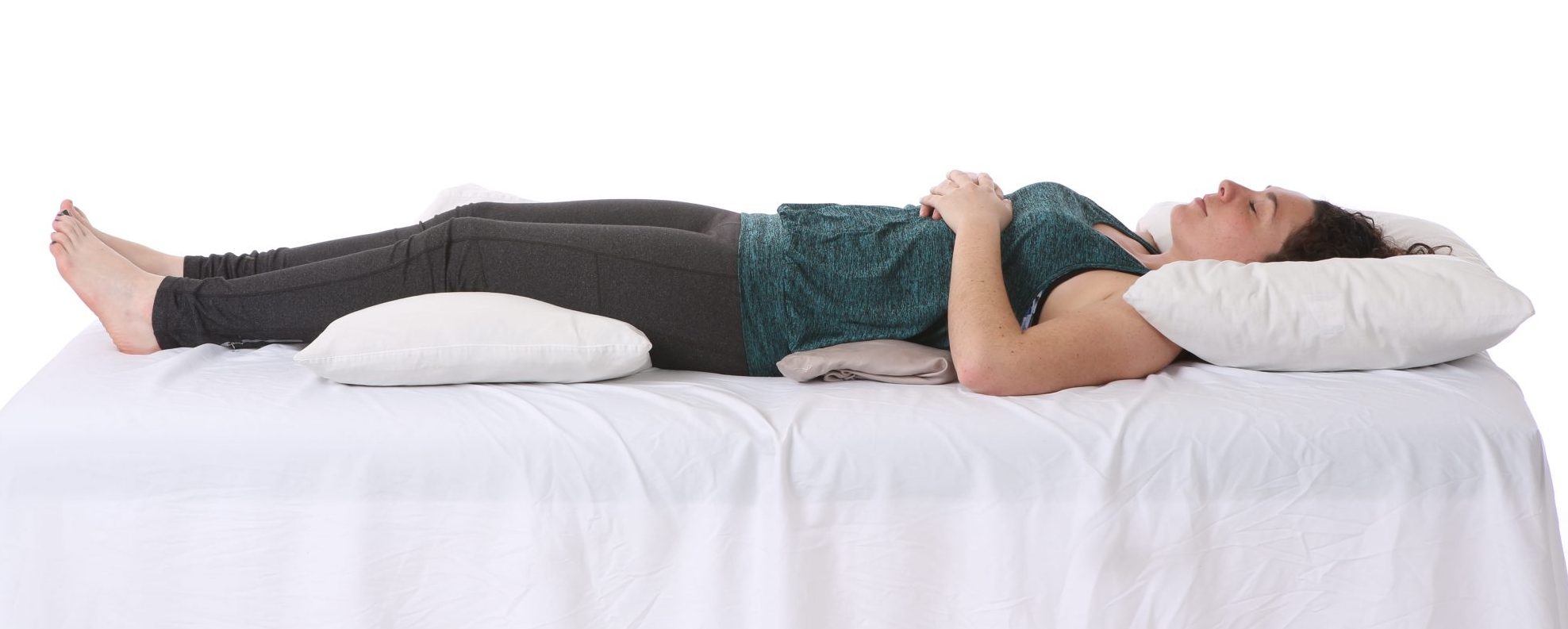
Sleeping on your back is generally excellent for your neck and upper spine because it evenly distributes your body weight across the widest surface of your body. However, for the lower back, flat back sleeping can be highly problematic. The natural arch of your lower back is left completely unsupported, causing the surrounding muscles to tense up in order to bridge the gap between your body and the bed.
The straightforward solution is to bend your knees. By placing a supportive pillow or a cylindrical bolster under your knees, you allow your pelvis to tilt backward slightly. This posterior pelvic tilt effectively flattens your lower back against the mattress, closing the gap and allowing the lumbar muscles to completely disengage and relax. If you struggle with sciatic nerve pain, this position can be particularly relieving, as it reduces the tension on the nerve pathways that run down the back of your legs. If one pillow is not quite enough to flatten your back, experiment with two, or use a specialized foam wedge designed specifically for knee elevation.
The Stomach Sleeper’s Dilemma
From a biomechanical standpoint, stomach sleeping is widely regarded as the worst possible position for your spine. Lying on your stomach forces your neck to be rotated to a near ninety-degree angle for hours at a time, which severely impacts the cervical spine. More importantly for the lower back, this position causes your heavy abdomen to sink deeply into the mattress. This amplifies the inward curve of your lower back, pushing it into an exaggerated arch known as hyperlordosis. The result is intense, sustained compression on the facet joints at the back of your spine.
If you have spent your entire life sleeping on your stomach and find it impossible to fall asleep any other way, you must make immediate modifications to protect your lumbar spine from further damage.
Modifications for Stubborn Stomach Sleepers
The primary goal here is to flatten the lower back and reduce that exaggerated arch. To accomplish this, place a thin, firm pillow directly under your pelvis and lower abdomen. This slight elevation acts as a counterbalance, lifting your hips and bringing your spine closer to a neutral, horizontal line. Furthermore, you should eliminate your head pillow entirely, or use a remarkably thin one. Elevating your head while you are on your stomach only forces your spine into a deeper, more painful backward bend.
Reclined Sleeping for Specific Spinal Conditions
While horizontal sleeping positions work exceptionally well for most muscular back pain, certain structural conditions actually benefit from an angled approach. If you suffer from isthmic spondylolisthesis—a condition where one vertebra slips forward over the one below it—sleeping flat on your back can exacerbate the forward slippage and increase nerve pain.
For individuals with this specific diagnosis, sleeping in a reclined position is often the most comfortable option. An adjustable bed base allows you to elevate your head and your knees simultaneously, creating a hammock-like, zero-gravity effect. This specific angle relieves the pressure on the nerve roots and stabilizes the slipped vertebra. If an adjustable bed is not a realistic investment for your current budget, a high-quality, dense foam wedge pillow can effectively mimic this posture. You position the large wedge to support your entire upper back and head, while using a secondary pillow under your knees to maintain the pelvic tilt.
Beyond Posture: The Role of Your Mattress and Pillow
You can perfect your sleep posture, but if your foundation is fundamentally flawed, you will still experience pain. A mattress that is too soft will allow your heavier body parts, specifically your hips and shoulders, to sink too deeply into the material. This destroys your spinal alignment regardless of how many pillows you use for support. Conversely, a mattress that is excessively firm will fail to contour to the natural curves of your body, creating intense pressure points and forcing your spine out of alignment to compensate.
The ideal mattress for lower back pain typically falls in the medium-firm category. It provides enough surface tension to keep your spine properly aligned horizontally, but offers enough targeted pressure relief to accommodate the natural contours of your hips and shoulders.
Your head pillow is equally critical to this equation. Its sole purpose is to fill the empty space between your neck and the mattress. If you sleep on your back, you need a relatively thin pillow with extra support under the curve of the neck. If you sleep on your side, you need a thicker pillow that matches the exact distance between your neck and the point of your shoulder. If your head is tilted up or dropping down, that misalignment in your cervical spine will eventually travel down the kinetic chain, manifesting as referred tension in your lower back.
The Process of Retraining Your Body
Changing the way you sleep is notoriously difficult. You will likely wake up in the middle of the night having kicked your knee pillow onto the floor, only to realize you have rolled back into your old, unsupportive posture. This is an entirely normal part of the process. Your body has spent years, perhaps decades, adapting to your current sleeping habits. Muscle memory takes time to overwrite, and your nervous system needs time to adapt to feeling safe in a new position.
When you wake up in an unsupportive posture, do not get frustrated. Gently correct your position, retrieve your pillows, and try to go back to sleep. Over a period of several weeks, your nervous system will begin to recognize that the new, supported positions are actually safer and physically less painful. Consistency is the only way forward. By committing to these structural adjustments and prioritizing spinal alignment every single time you get into bed, you can successfully transform your sleep environment from a source of daily pain into a vital tool for physical recovery.